
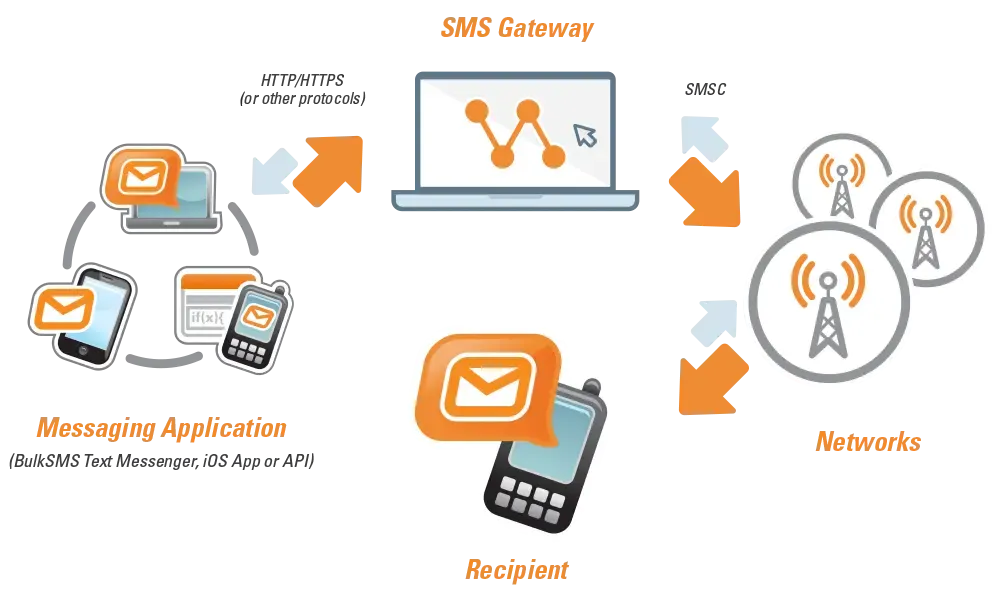
Short answer: an SMSC (Short Message Service Centre) is the mobile operator's system that stores and delivers text messages on its network. An SMS gateway is a provider's platform that connects businesses to the operators' SMSCs and handles routing, queuing, sender IDs and delivery reports. An SMS API is the interface your software uses to talk to the gateway, usually an HTTP (REST) API or SMPP. A business message travels API → gateway → SMSC → phone, and the delivery report travels back the same way.
This article explains the technology. If you are deciding what to buy, read SMS gateway vs SMS API vs bulk SMS portal: which one do you need?
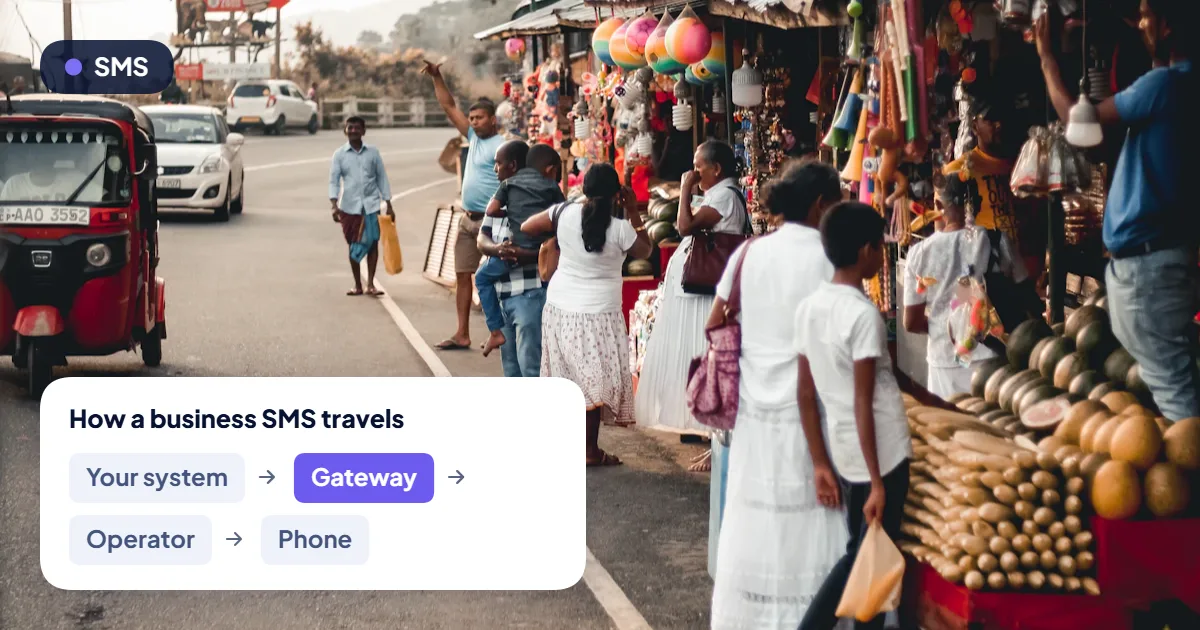
How a business SMS travels, step by step
- Your system makes a request. An app, website, CRM or web portal asks to send a message, for example an OTP or an order update.
- The SMS API receives it. The request arrives over an HTTP API or an SMPP connection, with the recipient, the text and the sender ID.
- The gateway prepares and routes it. It checks the sender ID, works out the encoding (GSM-7 for English, Unicode for Sinhala or Tamil), splits long messages into parts and chooses the route to the recipient's network.
- The operator's SMSC delivers it. The SMSC stores the message and delivers it to the phone, retrying if the phone is switched off or out of coverage.
- A delivery report comes back. The SMSC reports whether the message was delivered, and the gateway passes that status to your system or dashboard.
SMSC: the operator's message centre
Every mobile network runs one or more SMSCs. They are the core of SMS on that network and are run by the operator, not by businesses. An SMSC:
- Stores and forwards messages until the recipient's phone can receive them.
- Delivers messages to phones on its network, or hands them to another network.
- Retries when a phone is offline or the network is busy, within a set validity period.
- Reports status through delivery receipts.
SMS gateway: the bridge between businesses and networks
An SMS gateway is what a provider such as Bloomwire operates. It connects to the operators' SMSCs and gives businesses one place to send through (for a non-technical overview, see what an SMS gateway is and how it works). A gateway:
- Connects to the networks, ideally directly. See zero hop vs one hop routing for why that matters.
- Routes and queues large volumes so messages go out quickly and in order.
- Manages sender IDs, so customers see your brand name instead of a number.
- Handles encoding and message parts: 160 characters per part in English, 70 in Sinhala or Tamil.
- Collects delivery reports and makes them available through the API and dashboard.
SMS API: how your software connects
An SMS API lets developers send and receive messages from their own applications. The two common options are:
- HTTP (REST) API: simple to integrate from almost any language, ideal for OTPs, alerts and order updates. Each message is a web request.
- SMPP: the telecom industry's binary protocol over a persistent connection, suited to high volumes and to systems that already speak SMPP.
Compare the two in REST API or SMPP for SMS in Sri Lanka, and see the SMPP API integration guide for connection details.
The three side by side
| SMSC | SMS gateway | SMS API | |
|---|---|---|---|
| Who runs it | The mobile operator | An SMS provider | The provider, used by your developers |
| What it does | Stores and delivers messages on the network | Connects businesses to networks, routes, manages sender IDs and reports | Lets your software send and receive messages |
| Who uses it directly | Operators and connected providers | Businesses, through a portal or API | Developers and integrated systems |
What this means when you choose a provider
- Ask whether the provider connects directly to the Sri Lankan networks or through intermediaries.
- Check that delivery reports are available per message through the API and dashboard.
- Make sure the API options fit your system: HTTP for most applications, SMPP for high-volume platforms.
- Confirm that sender ID registration is handled for you. Our 2026 sender ID guide explains the rules.
Bloomwire's SMS gateway and API sends over direct operator routes, with delivery reports, branded sender IDs and both HTTP and SMPP access.
Frequently asked questions
Do I need my own SMSC to send business SMS?
No. SMSCs are run by the mobile operators. Businesses send through an SMS gateway provider that is connected to those SMSCs.
What is the difference between an SMS gateway and an SMS API?
The gateway is the platform that connects to the mobile networks and delivers your messages. The API is the interface your software uses to send messages through that gateway.
Does an SMS API send messages straight to the phone?
No. The API passes the message to the provider’s gateway, which routes it to the recipient’s mobile operator. The operator’s SMSC delivers it to the phone.
Where do SMS delivery reports come from?
The operator’s SMSC reports whether each message was delivered. The gateway receives that report and makes the status available through the API and dashboard.
Should I use an HTTP API or SMPP?
Use an HTTP (REST) API for most applications, such as OTPs, alerts and order updates. Choose SMPP for very high volumes or if your platform already uses SMPP.